Praise for Elohim Adonai
- Material
- Painted steel and timber

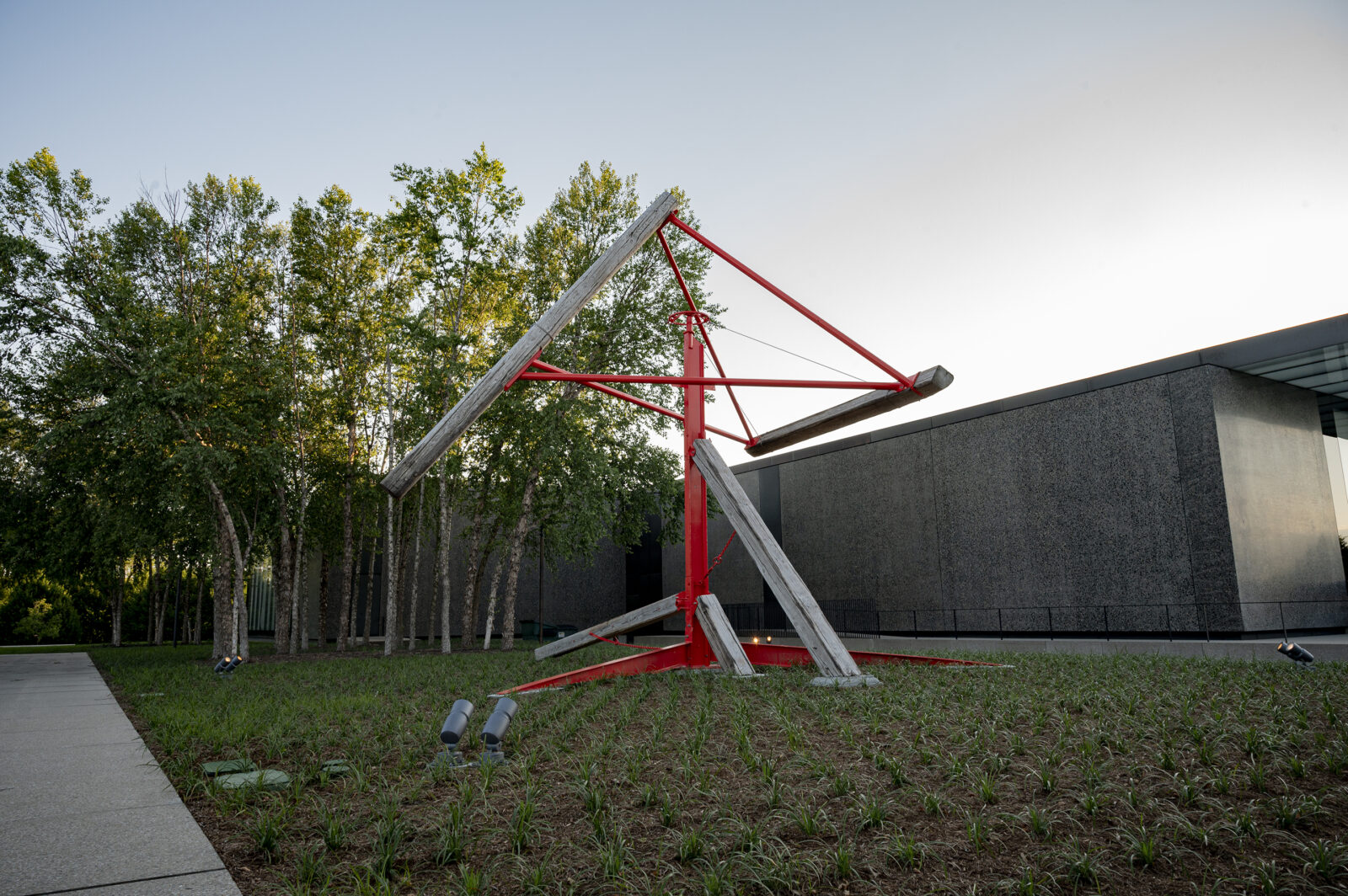
Mark di Suvero, American, born 1933; Praise for Elohim Adonai, 1966; painted steel and timber; 22 x 30 feet; Saint Louis Art Museum, Funds given by Mr. and Mrs. Norman B. Champ Jr. 31:1967a-m; © Mark di Suvero, Courtesy of the Artist and Spacetime C.C.
Acquired in 1967, Mark di Suvero’s Praise for Elohim Adonai has returned on view at the Saint Louis Art Museum for the first time in more than 30 years. It was installed on the lawn in front of the museum’s East Building earlier this year.
The massive kinetic sculpture is made up of two parts, each containing wooden timbers and painted steel beams: the top component balances on a fixed vertical axis and rotates when blown by the wind. The lower part weighs 4,400 pounds (approximately the weight of an adult male Javan rhinoceros) and the upper—a tetrahedron, or triangular pyramid—weighs 3,300 pounds. The entire piece measures 22 feet tall and 30 feet wide.
It returned to SLAM after an extensive 13-month conservation project at a conservation service provider in Ohio. Rotted timbers were replaced with reclaimed 50-year-old spruce, which ensures they are dry and not likely to change dimensionally. The steel was repainted a shade of orange, as approved by di Suvero’s studio.
Mark di Suvero, American, born 1933; Praise for Elohim Adonai, 1966; painted steel and timber; 22 x 30 feet; Saint Louis Art Museum, Funds given by Mr. and Mrs. Norman B. Champ Jr. 31:1967a-m; © Mark di Suvero, Courtesy of the Artist and Spacetime C.C.
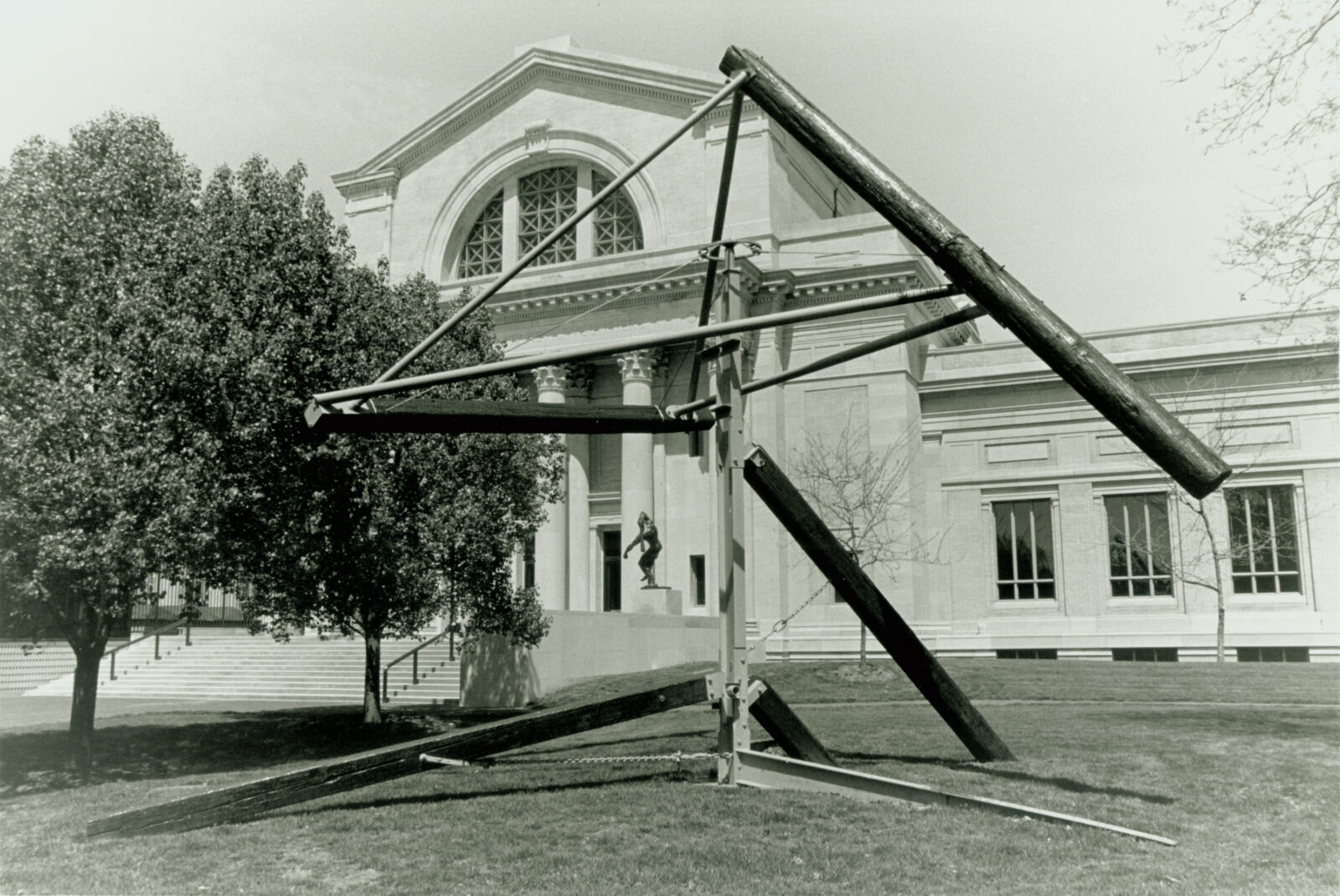
Praise for Elohim Adonai made its SLAM debut in 1967 as part of the 7 for 67: Works by Contemporary American Sculptors exhibition, which was curated by Emily Rauh (now Emily Rauh Pulitzer) and introduced Museum visitors to a generation of artists including di Suvero, Christo, Donald Judd, Claes Oldenburg, Lucas Samaras, George Segal, and Ernest Trova. After the close of the exhibition, Judith and Norman B. Champ Jr. gave funds to purchase the di Suvero work.
The piece was on display outside the Museum for a number of years in the late 1960s and ‘70s, as well as for a period in the 1980s. It also traveled as part of loan agreements with other institutions and was last on view in Nice, France, in 1991. After it returned to St. Louis, it went into storage. Now, restored and reinstalled on the lawn in front of the East Building, it has been placed near two other works by American artists also known for monumental sculpture, Claes Oldenburg’s Giant Three-Way Plug, Scale A and Richard Serra’s To Encircle Base Plate Hexagram, Right Angles Inverted.
Praise for Elohim Adonai by Mark di Suvero installed in front of the Museum's south facade, c.1970
The artist, who is 90 years old and still practicing, is known for his Abstract Expressionist sculptures and has compared his works to “drawings in space,” translating the language of Abstract Expressionism into large-scale sculptures.
Born to Italian parents with Sephardic Jewish ancestry, di Suvero lived in China as a child before the family moved to California prior to World War II. He studied philosophy at the University of California, Berkeley, then moved to New York City in 1957 where he worked in construction. It was then he started practicing art using found materials from a scrapyard. He’s known as one of the first artists to use a crane as a sculptural tool.
Praise for Elohim Adonai was created in a Brooklyn junkyard in 1966. Most of di Suvero’s later sculptures featured only painted steel, but this early, hybrid work is made of painted steel, wood, and cables. Though the artist is not known for discussing religion, the title of the work, Praise for Elohim Adonai, translates in Hebrew to “Praise for the Lord our God.” It was made during a time of the artist’s growing sentiment against the Vietnam war.
Other large-scale di Suvero works can be seen in St. Louis at Laumeier Sculpture Park and at City Garden.